Showing posts with label trimming. Show all posts

Friday, August 29, 2008

All Weather Tread for Brego

In general, Brego does well barefoot. He has been conditioned since I have had him to travel over rocks and uneven terrain without shoes. When we were in Texas, almost all of our rides out involved rocky terrain and Brego did pretty well if kept in reason. For example, I could ride him walk/trot on a 12 mile trail ride over rocks and he would be fine. But if his feet had been soaking in mud for the two weeks prior, it was time to break out his #7 Easyboots.

In the semi-arid climate of Central Texas, you could very easily never ride in mud. The occasional times that it rained enough to cause excessive mud, you could scratch or, better yet, the entire show would be canceled. Thus, I rode for two great years without ever negotiating mud.

Then I moved to New England. Where it actually rains. Sometimes daily. As I am discovering, the barefoot program that worked in Texas may not work so well up here. The jury is still out, but as with all things horses, I am continually learning.

The biggest problem I am facing up here in regards to footing is traction. Brego is still fine over rocks, even with all the wet weather. He is not foot sore or gimpy when we ride out, which is, admittedly less than we rode in Texas. But in the mud, Brego will slip behind.

The kind of mud up here is thick and deep. It's not a thin, watery mud that you can strike through and find purchase on something solid underneath to push off. It's all slick, all the way down. Brego, with his free swinging rear legs, slips in the mud. It could very well be that he is barefoot. Even a flat shoe would offer some grip, I would think. Would it be enough grip in the thick mud to stop him from sliding? That's a big question I have.

Brego might also be slipping because he is honestly not trained to negotiate footing. When all you do is ride on dry, packed earth, it may take some adjustment to center your weight a bit more. Or he could be slipping more because of the way he lands on his hind feet. He swings his rear legs through, in typical cow hocked fashion, by swinging his hoof to the inside, very close to the opposite leg. Then as the foot travels forward, instead of swinging it back out for a nice, even flat landing, he keeps his foot to the inside and places the outside of his hoof wall on the ground first. As his weight transfers onto the hoof, the inside of the hoof comes down to make contact with the ground. So he's not traveling square. This seems to be a breed-specific "feature". I've seen lots of Percherons do this. Being bred to be base-narrow and walk in a furrow has a lot to do with this, I believe.

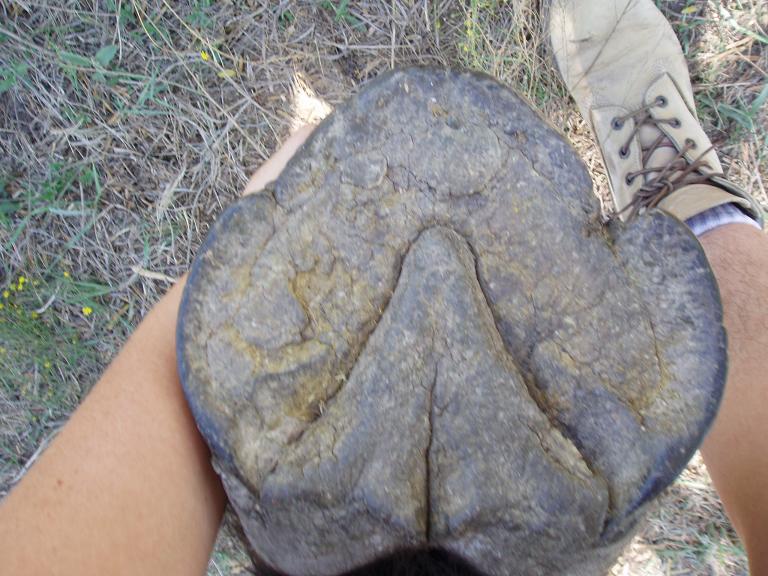
Landing on the outside of hind foot, sometimes worse than others

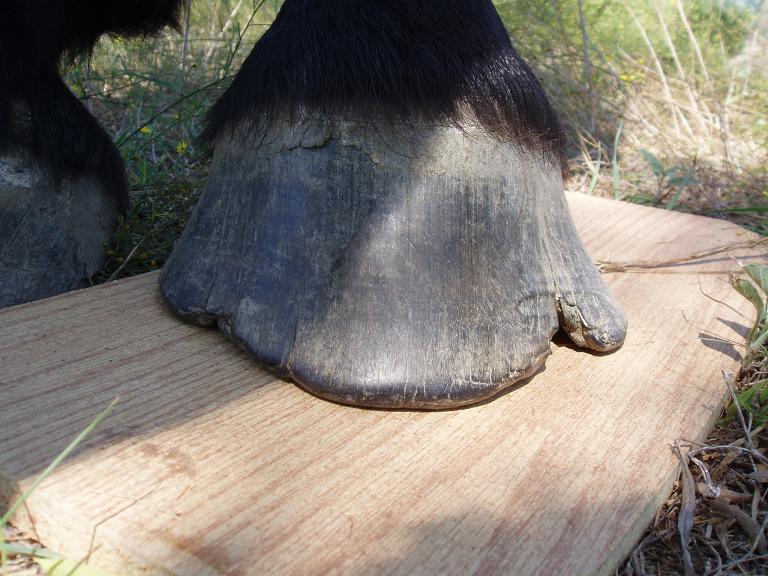
This inside travel also has ramification on his hoof development. The outside of his rear hooves are extremely flared and must be trimmed every few weeks to keep his wall from being pushed up on impact and flaring worse. I am of the opinion that you should not correct this type of conformation flaw with shoeing, even if it might be possible. Brego is what he is, and sometimes corrective shoeing will transfer the stress up the leg to his hock or his hip. With his hoof wall being stressed, I can monitor it and he is sound and uses the rest of his hind end well. Of course, I can't predict the future, and he might go lame in 4 years no matter what I do because of this conformation. Such is the nature of horses.

So, knowing that he has such uneven travel, and knowing that his hoof wall is doing a pretty good job and handling that stress and keeping it from impacting the rest of his leg, I am loath to put him in flat shoes permanently. I can't image what might happen to his fetlock if his flared wall was held immobile by a steel plate as he added weight. The double impact of first the outside of his hoof and then his inside might be exacerbated by a non-forgiving shoe.

As a quick aside, I don't believe that all shoeing is evil, but I believe that poor, uneducated shoeing will wreck a horse. I almost lost a mare to ignorant shoeing before I educated myself enough to put a stop to the increasingly debilitating shoes. She went barefoot for seven years and now, as she gets older, she needs simple flat shoes to be comfortable again. Fair enough, I do what is right for that horse. Brego is 95% fine without shoes. The missing 5% is traction. I am not about to mess with the 95% goodness by putting shoes on him until I have exhausted all other options.

So what are my options? Assuming that Brego will not magically learn to travel safely in mud and will need some sort of assistance to compete in New England, what can I do?

Option #1: EasyCare, the fine people who bring you Easyboots, makes a "extreme" boot meant for sloppy conditions called the Easyboot Grip. This boot sounds perfect for what I need. Just slap some boots on his hinds when needed during a competition and the rest of the time, his hooves can rest and keep doing what they are doing. One small snag in this great plan: They don't come in sizes big enough. The Grips only go through #3 and Brego is a #7 up front, probably #6 behind. I contacted EasyCare and they do not have any plans, that they told me about anyway, to make them in bigger sizes. Phooey.

Option #2: Take an existing pare of Easyboots and drill and tap them for studs. All the benefits of studs, without the nailing of a shoe. Right now, I only have Easyboots for Brego's front feet, but his hind feet need the traction. So he would need to be sized and they would need to fit PERFECT to avoid slippage and damage to Brego from a loose boot. I would need to drill and tap the studs (oh yea, buy some studs) and educate myself on when to use studs. This is not such a bad plan, except I hate the Easyboot clasps. EasyCare is supposed to come out with a new clasp, call the Edge, which does not use the little metal cables to secure the boot. I would much prefer the new clasps, less danger of catching on a fence or getting damaged and broken by a rock. But again, when the Edges come out, they may not be in a size big enough for Brego.

On to Option #3: Shoes for Shows. I can put hind shoes on for big shoes, have them tapped for studs. Then after the show, have them removed. There's a couple of big question marks around this option, above and beyond the "traveling" issue I outlined above. Getting a competent farrier who will shoe drafts and do what I want is one. I have not been impressed by the farriers around here. I've never seen so many toed-in, paddling, heel stacked horses in my life. Plus, most farriers will want to put on front shoes, so that would be a battle. I've already been lectured by a farrier that it is IMPOSSIBLE to keep a draft barefoot. That was a fun conversation... No really, I just want hinds. Then there is the question of how will Brego handle the shoes? Probably fine, but he's never been shod in his life. So I would probably need to put them on in enough advance of a show to get them off if he is troubled.

All these thoughts have been running around in my head before I went to the big recognized show. I had some trouble with slipping at schooling shows and I was pretty nervous about how Brego would do barefoot. I watched most of the rides of the day, from the training-level big Thoroughbreds, to the Beginner Novice-level ponies. Some horses had flat shoes. Some horses had shoes with studs. Some horses were barefoot. Everyone had trouble with the wet footing. I saw horses with studs slipping in the mud, front and back. Brego slipped on course once during show jumping. He did not slip at all on cross country, which was pretty wet. But I was very mindful of the footing and so we went an appropriate speed through the wet parts. (So maybe I have a rider education problem??) So all in all, I think he fared as well as the other horses.

So do I really have a traction problem? Or is an occasional slip to be expected and horses and riders learn to just move on? Remember, I have never ridden in mud before, so I am not sure what is normal. Since Brego did so well at the show, I am not pressed to solve this problem today. However, I am going to start working towards Option #2 with the Easyboots that are currently available. The upcoming Autumn will tell me more about whether Brego and I will adjust or if we have a real problem. If Option #2 does not work, I am on to Option #3. I don't mind putting shoes on for a show, but I don't think I am to the point that I will put shoes on Brego permanently for traction. Now, if he started being foot sore, then that's a different ball game.

Everyone tells me that I must put shoes on for the winter in New England, must have borium. But I have met several riders who ride their horses out all year round barefoot. Like all things, it depends on the horse and the level of work. So I need to find a solution that works for both of us and keeps Brego as sound as possible for as long as possible. As always, I reserve the right to change my mind, and my course, at any point. :)

Tuesday, January 1, 2008

Trimming XXL Feet

The long awaited trimming post has arrived! I am going to detail as much of the trim as I can, considering I am not the primary trimmer. I will relay any specific questions to the main trimmer and answer them as best I can.

To my knowledge, Brego has never worn shoes. Or if he has, it was very early in his life. I know his history from 3 years old and on, and he has been barefoot the entire time. When I bought him, he would not pick up his feet and his hooves were extremely overgrown. His previous owners had taken good care of him, and he was in a good weight, but his feet were pretty neglected, with severe flaring all around the hoof capsule, from the toe to the heel.

In his third year, before I got him, he was housed on a sand paddock and not ridden at all. In fact, the people I bought him from were pretty intimidated by him. They told me the story that the people they had bought him from said he bucked under saddle so they never really worked with him. The end result was that his feet continued to flare on the soft ground and there was no natural wearing or chipping action to help alleviate the overgrowth.

When I bought him, I knew very little about feet. I noticed he had no contraction of his heel and nice large frog and was largely satisfied. My first few trims were a learning process, where I just trimmed his hoof wall back to stop the flaring and did little to balance his foot overall. He has always been sound, even with the incredibly long feet, and he was sound after my trims so I was not too concerned. During the first year and a half that I owned him, he was turned out on 80 acres of black-land prairie which gets quite hard in dry conditions. He was in a large herd of horses so he moved around quite a bit, and I think that had a lot to do with his feet remaining good and sound, even with my uneducated trim.

Last January, I moved him to a "better" facility which had arenas and jumps for training, but he was in an enclosed paddock, just 2 acres, with 7 other horses and 3 donkeys. The ground was terrible, a thick mud, and the paddock was never picked, so he ended up standing in manure and urine and had very little movement. I fought with the barn owner for turnout, as they had originally advertised, and I was lucky if he got turned out into a 10 acre pasture for a few hours five days a week. His feet completely degraded and he lost a lot of conditioning. His hoof wall would flake and peel, completely corroded, and his sole dropped to the ground. He lost the concavity his feet had gained the previous two years. For the first time, he started to be sore over rocks. It was during this time that I found a better trimmer for him, since I doubted my ability to keep him going under those conditions.

Last August, I moved him to a new facility, where he has a 7 acre grass pasture that he shares with only Hobby. This means that with proper rain, the pasture will continue to hold grass and not descend into a muddy hole. He also has more movement, although not nearly as much as he had in the herd environment on 80 acres. His exercise level has vastly increased, as he has come of age and I have put him into serious training. It has taken about 6 months of careful conditioning over rocky trails to begin to get back some of his ability. He still gets foot sore if the rocks are too big, but he can handle a typical Hill Country trail for 12 miles at least, when his feet are dry.

I have included this information, because environment is 50% of the battle with keeping a horse comfortable barefoot. There are some environments where a horse cannot be barefoot, no matter how good the trimming or how naturally predisposed the hoof is. Very prolonged wet conditions, or conditions where the horse cannot have adequate turnout really work against the natural mechanisms needed to keep the hoof healthy. Also, the goals of the rider are also a factor. If the rider desires the horse to be able to go 50 miles over rocks barefoot, then they must expend considerable energy conditioning and acclimating the horse to rocks. It is possible, but it's very hard. Better to go with shoes or boots to protect the non-acclimated hoof. If the goal of the rider are to be sound in a sandy arena and well groomed cross country course, the conditioning is much less severe, but traction must always be a consideration.

I have ridden Brego in knee high wet grass at a canter and never felt a slip, but I would certainly scratch before I did any jumping or speed work at a competition in those conditions. It's about priorities and being realistic. I believe a well conditioned barefoot horse gives me the most options: I can put on boots (if they will fit), I can put on shoes for studs, I can leave him barefoot, etc. So I try to keep him barefoot and progressing, but I am very realistic about his abilities. Once you put shoes on full time and lose the natural conditioning, you must stay with shoes or boots and you have fewer options. Not a big deal for full-time show competitors, but a big deal for me because I have many interests and activities with Brego.

I won't go into all the arguments for or against barefoot, just say that I have done my research and am seeing how things go. I am not close minded one way or the other, and Brego will tell me what he needs to be comfortable.

Ok on to the trim, which was performed on December 17, 2007 (Click on the pictures to see larger versions):

Here are Brego’s feet pre-trim.

He toes in significantly, which is common in draft horses. His is also base narrow and tends to paddle. Draft horses are purposely bred this way so they can walk comfortably in a furrow. Great for plowing, not so great for everything else.

His feet are 7.5 inches in width and slightly less in length, which is why most boots do not fit. Most horses feet are longer than wide, but Brego and a couple of the other drafts I have known are the opposite. These boots are shaped more appropriately for horses like Brego and I have ordered the largest size they have which just might work. I will keep you all posted.

He has an old injury on the outside side of his left foot. It looks like it was some sort of injury to the coronet band that has altered growth of the hoof wall on the lateral side of his hoof. While the injury has not completely “grown out” in the two plus years I have had him, it does appear to improve with new wall growth.

Brego’s feet are trimmed approximately every four weeks. Between trims, we bevel around wall to promote breakover, hinder flares, and prevent wall chipping. Pre-trim, you can see that his feet have flaring all around. We will focus on his left front for a specific trimming explanation.


Here is the lateral side of the left front before the trim. You can see the injury area near the edge of the hoof wall.
Halfway down the hoof on the toe, you can see where the flare starts. We have been aggressively addressing his flares, and this seems to be working as the top part of the wall is more straight. We address the flares by keeping the hoof wall short and beveled.
The heel is very long and run forward.

In the heel picture, it looks like the medial heel of the hoof might be a bit longer than the lateral side of the hoof. This is consistent with the front picture of the foot, which looks like the coronet band is angled upwards on the medial side and not level.


Here is the post trim of the front feet. Flaring has been removed on the lower third of the feet.


Here is the lateral side of the left front. You can see the flare that has been removed. The heel has been lowered. His injury is causing the significant float in the quarter area. We are hoping that this continues to grow down properly so that the hoof wall can be in ground contact all around, with only the *slightest* quarter scoop. Hoof care practitioners disagree on the need for a quarter scoop; some argue that hooves need a quarter scoop for hoof expansion purposes. If the coronet band bulges upward in the quarter area, the trimmer puts a scoop there to help straighten the band. If the band is straight, she bevels the wall and adds a very slight scoop depending on the horse.

In the post-trim heel picture, the medial heel has been lowered so that it is more in balance with the right heel. We have also cleaned up the frog flaps and opened the central sulcus area of the frog so that thrush or fungus does not get trapped in the area.

You can see that Brego’s soles are quite flat. We would like to see more concavity built up. This is the loss of concavity I talked about above, where he stood in mud for months with his feet breaking down.

We have taken the advice of Brego’s osteopath to rasp a 45 degree bevel into the medial heel so that he is weighting that heel more forward than the lateral heel. This is supposed to help with the toeing-in and the paddling when moving. While I have never heard of this, we are trying this for a few trims.

I must stress that “fixing” toed-in feet by trimming or shoeing can cause serious problems if you end up putting stress on the limbs. I asked the osteopath about this, and while he agreed that Brego’s feet will always toe in due to confirmation, he thought that some of the toeing-in was excessive. We will keep you updated on this, and I will ask the osteopath for more information on this method when Brego sees him in March.

I am also going to get a full set of films of his feet done this week, before we start spring training. The best way to keep track of his progress, or lack thereof, is to get baseline xrays and then checkpoint with them annually. Plus, they should be useful to my trimmer, to help her see what his feet are doing on the inside.